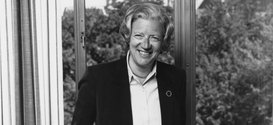
At first glance, Annie McClure Hitchcock's pledge in 1899 to build a men's residence hall appears to be simply another magnanimous gesture by a local Chicago donor. Hitchcock mirrored other women donors by making a sizable donation in honor of her late spouse, Charles Hitchcock. William Rainey Harper sent her several letters thanking her profusely and then updated her on the planning of the building. Surviving letters also show that Annie Hitchcock reviewed the invitations for the hall's formal dedication ceremony before they went to their final printing. From these details emerges a portrait of an aggressive, self-willed philanthropist who knew exactly what kind of building she wanted to erect. Indeed, Hitchcock's activist style of giving not only challenged the architectural standards set by the early Trustees led by Martin Ryerson and Charles Hutchinson, it also raised the more profound question of the right of donors to participate in making policy decisions. Annie Hitchcock (1839-1922), a native of Chicago, decided to build a permanent memorial to her husband, wealthy lawyer Charles Hitchcock, after his death in 1881. She announced in 1899 her intention to donate the funds needed to build a men's residence hall at the University of Chicago, providing $159,499 for construction and $25,000 for maintenance.
Upon learning of Annie Hitchcock's generous gift, University Trustee Charles Hutchinson, the chair of the campus planning committee of the Board, unwittingly angered Hitchcock by commissioning Charles Coolidge of the Boston architectural firm Sheply, Rutan and Coolidge to submit sketches for the building. "I am not content," Hitchcock wrote in an agitated letter to Harper, "that the building should be put up as my expression of an adequate memorial to my husband, and as my ideal of what a boy's dormitory should be, when I have not been consulted at all." Realizing that the Board of Trustees' break with architect Henry Ives Cobb in 1901 opened the way for the possibility of new architectural visions on campus, she lobbied strenuously to have the commission go instead to the rising young architect Dwight Heald Perkins. Sensing promise in Perkins, she had financed his education at the Massachusetts Institute of Technology; now she wished to help him further by ensuring that he would design a building to her specifications. Hitchcock had no doubt that Perkins was a wise choice-he was already working closely with some of the most progressive figures in Chicago architectural design, including Frank Lloyd Wright, Myron Hunt, and Robert C. Spencer.
Several influential Trustees resisted Hitchcock's intervention in campus planning, and they were even less enthusiastic about giving Perkins the commission. Nevertheless, Hitchcock prevailed, and the young architect set to work on the plans. Hitchcock Hall was completed September 1902 and occupied in October. It was like no other building on campus. Cloaked beneath a Gothic exterior highlighted by angular modern accents, the building's interiors blended the aesthetic of the Arts and Crafts movement with the horizontal modern style of the Prairie School. After the building's construction and occupation, Hitchcock continued her activist role in its management. She visited the residence hall frequently, and she donated carefully selected furnishings and books to elevate the social life and domestic culture of the male students it housed.
Innovations in educational thought matched those being made in science on campus in the early decades of the twentieth century. Educational reformer John Dewey's appointment to the faculty in 1894 signaled a substantial commitment by the University of Chicago to test new teaching practices and to implement new pedagogical theories. Indeed, the creation of the Laboratory School under Dewey's leadership immediately put the University on the national educational map. But to sustain Dewey's high ambitions, University administrators needed the financial resources that only a major philanthropist could provide. Into the breach stepped Anita McCormick Blaine (1866-1954). The daughter of industrialist Cyrus Hall McCormick and his wife Nettie, Blaine made a substantial gift for a building to house the University Elementary School and University High School on campus-Emmons Blaine Hall. Moreover, Blaine also provided funds to subsidize the University's programmatic work in education, a welcome expansion of the horizon of philanthropy beyond that of the first cohort of Chicago donors, whose gifts had been directed largely to building construction.
The cause of improving primary and secondary education deeply interested Anita McCormick Blaine, perhaps a reflection of the minimal education she received as a child. Believing that the existing methods of primary instruction were ineffective, Blaine searched for the right person to be her standard bearer, and she found him in Colonel Francis Wayland Parker. Since the 1870s Parker had experimented with new methods of teaching, rejecting the idea that students learned best by rote memorization. Parker's unconventional opinions (e.g., his rejection of the traditional division of subjects, his emphasis on parental involvement, and his insistence on practical learning) attracted much criticism, but Blaine became an ardent and enthusiastic supporter. In 1899 she urged Parker to establish a unique private school on the city's North Side, in which she could enroll her son Emmons, offering to fund the plan herself.
With Blaine's patronage Parker opened the Chicago Institute in 1900 in a rented German Turngemeinde, or athletic club, on North Wells Street. Plans had been developed for an impressive new building and elaborate curriculum for the Institute, but when expenses skyrocketed Blaine and Parker began to consider alternate possibilities. They found a resolution to their dilemma in a plan worked out by William Rainey Harper to incorporate the school within the University of Chicago as a part of its educational program. Blaine then announced that she would transfer her pledged investment of $700,000 in the Chicago Institute to the University of Chicago. By 1901 Blaine and Parker's enterprise had been merged with Dewey's experimental school, laying the foundations for the University's School of Education and for the modern Laboratory Schools of today. All that remained was for the new entities to receive a worthy and permanent home, which they acquired in 1904 with the completion of Emmons Blaine Hall. At the building's dedication ceremony, Blaine clarified her role in the establishment of the School of Education. "I did not found it," she affirmed. "I simply found it."
Ever a political, social, and religious non-conformist, Blaine supported a system of profit-sharing for her family's reaper business, instituted an eight-hour day for her household staff, became interested in spiritualism, and supported leftist politicians. Her endorsement of progressive Henry Wallace for President of the United States in 1948 perplexed even her closest friends and drew harsh criticism from right-wing commentators. But Anita McCormick Blaine went on to become an avid proponent of world government and international accord and remained committed to the cause for the rest of her life.
William Rainey Harper's death in 1906 was a severe blow to the University of Chicago community. Harper's courage, dedication, energy, and imagination had made Chicago into a distinguished research university, worthy of the best universities in Europe or America. In many respects, Harper was the University of Chicago, and his death produced understandable and powerful anxieties about the future. Who would succeed him as President? Could that person provide the leadership to sustain Chicago's greatness while also accommodating Rockefeller's desire for budgetary probity and stability?
Harry Pratt Judson's appointment as Acting President in 1906 and as President in 1907 did not put all such anxieties to rest, but in Judson the Trustees had identified a stable, respected, if unimaginative executive who could manage the affairs of the University. One of the first major policy decisions faced by the Judson administration was the question of how the University should honor William Rainey Harper, who clearly deserved a permanent memorial on the Quadrangles. Recalling Harper's long-standing desire for a permanent library building, Judson and the Board of Trustees decided to erect a new central library in his honor.
Appropriately, John D. Rockefeller made the first and largest contribution to the fund for the Harper Memorial Library. Within a week of learning of the Trustees' decision, John D. Rockefeller, Jr. wrote to them expressing his father's support and adding that "If the Trustees favor the erecting of a University Library in memory of Dr. Harper, my father will join with the Doctor's many friends in Chicago and the East in a contribution toward it." In the end, Rockefeller's "contribution" came to no less than $600,000, almost seventy-five percent of the total cost of the building when it finally opened in 1912.
Many other donors willingly matched Rockefeller's challenge, if on a more modest scale. Indeed, the subscription list for the Library fund reads like a "who's who" of Chicago's leading philanthropists and included many of the people who gave to other programs or units of the University. Anita McCormick Blaine, Ann Swift, La Verne Noyes, Helen Culver, C. K. G. Billings, Harold Swift, Julius Rosenwald, Catherine Seipp, and Frances Lillie each gave between $500 and $5,000 to the cause, while Martin Ryerson offered $25,000. National philanthropists such as Andrew Carnegie contributed, as did many University of Chicago alumni. Faculty members and students were also extremely generous, with faculty donations totaling almost $14,000 and the Classes of 1904 and 1905 channeling their Class gifts toward the memorial. By the time construction on the building actually began in 1910, over two thousand University supporters had contributed to the Harper Memorial Fund. While diverse in so many other ways, all of these donors were united in their admiration for William Rainey Harper and the extraordinary work that he had accomplished.
Windmills and wire dictionary holders may have generated the money that built Ida Noyes Hall, but the conviction that women and men should have equal access to services on the University of Chicago campus gave the building its real meaning. Before La Verne Noyes gave $500,000 in 1913 to erect the elegant building, men and women students had resided in separate (and unequal) social worlds. Although the University was founded as a coeducational institution, tendencies toward gender inequality were evident early on. When Reynolds Club (1903) and Bartlett Gymnasium (1904) were opened, the University restricted their use to male students. For group meetings and larger social gatherings, women students had only the inadequate quarters of Lexington Hall, a "temporary" brick building erected north of the President's House as part of the University's ill-fated sexual segregation scheme.
Born in Genoa, New York, La Verne Noyes (1849-1919) moved with his family to Iowa as a small boy and attended Cornell College in Mt. Vernon, Iowa. He began his career as an inventor when he went to work as a laboratory technician at Ames Agricultural College (now Iowa State University). He eventually left his job at the college and went into business for himself by producing and marketing machines and devices of his own invention. In 1877 Noyes married Ida E. Smith, and one of his most successful products resulted from Ida's difficulty in holding their heavy unabridged Webster's dictionary--Noyes designed a wire dictionary holder to aid his new bride, and soon patented the device for sales throughout the United States. Noyes's most lucrative invention came in 1886, however. This was the akromotor, a device that converted wind to electricity and proved to be immensely useful to American farmers in the late nineteenth century.
In 1879, the Noyeses moved to Chicago. With the success of La Verne's business enterprises over the next thirty years, the couple was able to lead a progressively more comfortable life and establish their residence in an elegant mansion at 1450 North Lake Shore Drive. Ida enjoyed traveling around the world, spending months at a time away from Chicago and her husband. She wrote him often from such exotic places as Paris, Jerusalem, and Hawaii. Noyes would occasionally join her on these trips, but his manufacturing business made it difficult to leave the city for extended periods of time. As his wealth grew, Noyes began to make substantial contributions to local charities such as the United Charities, the Park Ridge School for Girls, the Country Home for Convalescent Children, the local YMCA hotel, and the Chicago Half-Orphan Asylum. He also donated $10,000 in 1915 to create a reservoir on the campus of Iowa State in Ames, Iowa, which was named Lake La Verne.
Ida Noyes's sudden and unexpected death in December 1912 dealt La Verne Noyes a crushing personal blow. Seeking to honor his wife with an impressive and fitting memorial, he decided within six months of her death to give the University of Chicago a gift of $500,000 to build a magnificent new women's clubhouse. Dedicated on June 5, 1916, during the University's twenty-fifth anniversary celebration, Ida Noyes Hall was a splendid tribute to his wife's memory. Each year thereafter Noyes invited a group of senior undergraduate women students to his home for a special luncheon in their honor. Finally, in his last and most extraordinary gift, Noyes established the La Verne Noyes Foundation at the University in July 1918. With this foundation Noyes provided tuition scholarships to veterans of World War I and to their descendants. To finance this endowment, Noyes in the year before his death deeded all of his property, including his home and his manufacturing plant, to the University of Chicago -- a gift worth $2.5 million.
When Booker T. Washington called upon African Americans to gain formal education and work toward self-reliance, wealthy white progressives were spurred to provide America's black population with financial as well as rhetorical support. In the 1920s a number of American philanthropists, including Chicago's Julius Rosenwald, dedicated themselves to the challenge of confronting the unsolved national problem of racial inequality. Persuaded by Washington's concept of racial uplift, Rosenwald funded construction of 5,357 rural schools and related buildings for Southern blacks, ensured the construction and equipping of YMCAs open to all races, and served as trustee of the Tuskegee Institute in Alabama. He also gave thousands of dollars to progressive reform organizations such as Chicago's Hull House, supported medical care for Chicago's African-Americans through donations to Provident Hospital, and in 1929 built a low-income housing complex for the city's African-American populace. "Race prejudice is merely destructive," he said in an address to the American Missionary Association in 1911, because "it offers nothing but a hopeless warfare and a blank pessimism."
Born to Jewish immigrant parents in Springfield, Illinois, Julius Rosenwald (1862-1932) attained great financial and political power as president (1910-24) and chairman of the board (1924-32) of Sears, Roebuck and Company. A careful and judicious donor who gave in the hopes that others would do likewise, Rosenwald was an ardent advocate of a conception of philanthropy that focused on expendable rather than endowment resources. He published newspaper and magazine essays arguing that donors had a responsibility to make sure that their contributions were most effective in their own time, leaving the needs of the future to the generosity of donors who would surely come later. In a January 1929 Saturday Evening Post article he declared "that the needs of the future can safely be left to be met by the generations of the future. . . Like the manna of the Bible, which melted at the close of each day, philanthropic enterprises should come to an end with the close of the philanthropist's life." Funds for worthy causes should be given in a donor's lifetime, rather than by creating permanent foundations, because the subsequent administrative leaders of such foundations could easily ignore the original intentions of the donor. Each generation, Rosenwald firmly believed, was responsible for solving its own social problems.
Yet, even as Julius Rosenwald confronted some of the thorniest social policy dilemmas of his time, he also supported the cause of quality private higher education with magnificent gifts to the University of Chicago. Like his close neighbors and fellow Trustees Martin Ryerson and Harold Swift, Rosenwald maintained a residence just north of the University in the Kenwood neighborhood, where he owned a grand, if cumbersome mansion at 4901 S. Ellis Avenue. Like Ryerson and Swift, residential proximity to the University became one of many reasons for Rosenwald to give so generously. For such civic leaders the new University of Chicago was not only "Chicago's University," but also Kenwood's and Hyde Park's university as well.
Rosenwald's first donation came in 1904, when he contributed $6,500 to purchase the collection of German literary works that came to be known as the Hirsch-Bernays Library. Soon after his appointment to the Board of Trustees in 1912, Rosenwald surprised his fellow Trustees by pledging $250,000 to erect a building to house the University's Geography Department, Rosenwald Hall. Funds needed to build a library for the University's research center in Luxor, Egypt, followed, and in 1916 Rosenwald gave $500,000 to help launch the University's new medical school. He supplemented that gift in 1925 with a million-dollar donation to be assigned at the discretion of his fellow Trustees, and in 1928 he pledged $2 million toward the cost of erecting Burton-Judson Courts, the elegant residence halls for men located just across the Midway. An additional $250,000 gift from Rosenwald was designated to support the construction of the new Chicago Lying-In Hospital in the University's growing medical center.
BUILDING FOR A LONG FUTURE:
The University of Chicago and Its Donors, 1889-1930
To Next Section--PART THREE: SUPPORTING RESEARCH AND LEARNING